
 Australasian Code of Ethics for Direct Support Professionals
Free Download
Edited by Dr Keith McVilly & Assoc. Professor Christopher Newell (25 pages)
ASID has published a code of ethics to inform the education and training of direct support professionals. The code was co-launched in November 2007 during the Australasian-wide conference at Fremantle and the annual ASID DSW conference at Melbourne.
Twelve (12) ethical principles have been identified and a series of supporting guidelines developed. The guidelines are designed to inform the professional conduct of individual direct support professionals, for use as part of agency-based induction and in-service training and to inform curriculum content for TAFE, polytechnic, RTO and university courses.
The content of this first edition of the Australasian Code of Ethics for Direct Support Professionals is based on information gathered during a series of workshops conducted between November 2002 and November 2006, and a further Australasian-wide consultation during 2007. The workshops were conducted in every state of Australia and on both the north and south islands of New Zealand. Over 300 people participated in the workshops and contributed to the consultation. Contributors were predominantly staff engaged in the provision of direct support of people with disability, living in the community. They came from government and non-government sectors, and were working in the areas of accommodation, day support, education, employment and advocacy.
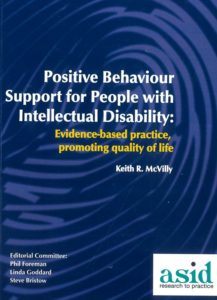 Positive Behaviour Support for People with Intellectual Disability: Evidence-based practice promoting quality of life

$66.00 Non-members | $55.00 ASID Members
Email the ASID Office to Purchase the Book – Unfortunately this book is no longer available for sale through ASID.
K. McVilly. First published 2003 (212pp.)
This accessible book is an essential resource for support workers and other disability professionals, educators and students in the intellectual disability field. It provides evidence-based information to help the reader understand challenging behaviour, to develop and implement behaviour support plans, and monitor those plans to ensure their ongoing effectiveness. Clear guidance is provided on ethical and legal principles underpinning behaviour support. Examples of charts and forms provide materials for use in practice.
Combining cutting edge research and contemporary best practice, this practical book presents a holistic, bio-psycho-social approach to behaviour support designed to promote quality of life for people with disability.
 Past Webinars
$20.00 Non-members | Free ASID Members
Non-members can email the ASID Office to purchase webinars
Past webinars are recorded and are available for purchase by non-members. Visit the Past Webinars page to see the webinars.